spynoodle
Active Member
I recently started overclocking my Geforce 8400 GS. I got it on ebay, and the seller is still selling the same model. The link to one of the current auctions can be found here: http://cgi.ebay.com/Nvidia-GeForce-...emQQptZPCC_Video_TV_Cards?hash=item4ced76678e
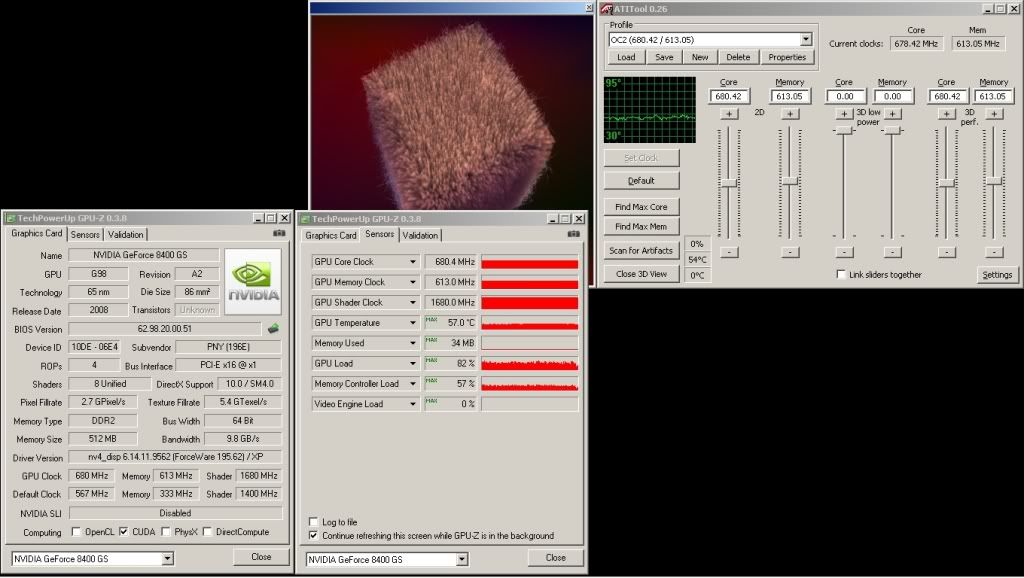
It has a G98 core, and today I got it from 540MHz GPU and 500MHz memory (mose likely half of the actual memory speed) all the way to 592MHz GPU and 603MHz memory. I thought it was stable, but at the very end of Game Test 4 in 3dmark it crashed on me. I still want to get it a bit higher. I overclock it with ATItool, but I also have Rivatuner. I heard that Rivatuner can raise voltages, and I want to try to do so. What is a safe interval to raise voltages by? I don't want to destroy my card that I just got to its full potential . I wouldn't usually dabble in voltage increases, but since my load temp WHEN OVERCLOCKED is still currently about 47 degrees Celsius, I feel pretty safe about temperatures. I would also like to get one thing cleared up: overclocking and voltage-increasing only damage a card or lower its lifespan when it gets hotter than usual, right? Is the temperature the only deciding factor in your card's lifespan increasing or decreasing?
It has a G98 core, and today I got it from 540MHz GPU and 500MHz memory (mose likely half of the actual memory speed) all the way to 592MHz GPU and 603MHz memory. I thought it was stable, but at the very end of Game Test 4 in 3dmark it crashed on me. I still want to get it a bit higher. I overclock it with ATItool, but I also have Rivatuner. I heard that Rivatuner can raise voltages, and I want to try to do so. What is a safe interval to raise voltages by? I don't want to destroy my card that I just got to its full potential
. I wouldn't usually dabble in voltage increases, but since my load temp WHEN OVERCLOCKED is still currently about 47 degrees Celsius, I feel pretty safe about temperatures. I would also like to get one thing cleared up: overclocking and voltage-increasing only damage a card or lower its lifespan when it gets hotter than usual, right? Is the temperature the only deciding factor in your card's lifespan increasing or decreasing?