dedicated physx card

I have dual gtx 690. Would it help physx performance to add a dedicated gtx 680 in addition? Is this possible?

No. There really isnt a game out right now that will push 2 690s. Even at high resolutions. The 680s and 690s and above are powerful enough you dont need one. I think you can also use your CPU for it but Im not sure, just make sure you have more than a quad core so in most games you will have some idle cores that could be made useful with physx possibly.

Also, you have 2 690s or 4? Isnt quad SLi 4 cards? Or does it count a single card as SLi for having dual GPUs on it? Either way, do you even have room for another card?? :p
 
690 SLI is considered 4 way SLI since there are 4 GPUs in the system.

A dedicated Physx card might give you a performance boost but it would be so small that it wouldn't be worth it at all. Keep the 690s till you want to jump to a newer generation all together.
 
690 SLI is considered 4 way SLI since there are 4 GPUs in the system.

A dedicated Physx card might give you a performance boost but it would be so small that it wouldn't be worth it at all. Keep the 690s till you want to jump to a newer generation all together.

So when you have a single dual GPU card the GPUs are running in SLi? What if the game does not support SLi does the card throttle down to a single GPU instead?
 
I can't really confirm for sure since I have never had a dual GPU card. But I think that Since both the cores are on the same PCB it would still work in games that do not support SLI. However 4 way SLI or Xfire would be reduced to the performance of one of the cards in the configuration. So still 2 way SLI in that case. My whole reasoning for that is I don't think that you need to manually enable SLI or Xfire when setting up Dual GPU cards like you would need to do for two single GPUs in SLI.
 
Last edited:
I'm pretty sure that there are two processors on the card and a SLI bridge built in, so that means with games that don't support SLI, one of the processors will be turned off.
 
Yes it would help. The CUDA cores on the quad 690 sli would be freed up for Physx used on the 680, but as I said in previous post, you may be offsetting that performance increase by the reduction in PCIe lanes that you're limited to with a 2700K. Additionally, your PSU is already near capacity so it would not be a good idea.

The only way to tell would be to download 3DMark11 (which uses physx)

Run it the following benches 3 times and get the average:

  1. 2700K dedicated to Physx - 1 GTX 690
  2. 2700K dedicated to Physx - 2 x GTX 690 quad SLI
  3. 2700K - 1 x GTX 690 dedicated to PhysX, 1 x GTX 690 not in SLI.
  4. 2700K - 2 x GTX 690 quad SLI - 1 x GTX 680 dedicated to physx.

Post score from those runs (run them each 3 times and average the results).

BUT! If you have a watt meter or a multimeter to test the 12V rail, because without a doubt, 5 x 680 cores will max that PSU. I would want to see you put an additional Corsair 450W PSU to run the mobo as although this is marketed as a single rail PSU, its, not, it has 4 x 12 Vrails with OCP which may make it shut down if you added the GTX 680 so be careful.

My guess is that your loss of PCIe lanes will outweigh the physx component and your scaling in real world gaming will be terrible. My guess (if you do the bench) is around 30% loss in performance due to PCIe lanes (8x rather than 16x) vs about 15% increase due to physx in the games that support it and benchmarks. So I expect a 15% reduction in performance between 2 and 4.

That is however with the disclaimer around the PSU.
 
Last edited:
Yes it would help. The CUDA cores on the quad 690 sli would be freed up for Physx used on the 680, but as I said in previous post, you may be offsetting that performance increase by the reduction in PCIe lanes that you're limited to with a 2700K. Additionally, your PSU is already near capacity so it would not be a good idea.

The only way to tell would be to download 3DMark11 (which uses physx)

Run it the following benches 3 times and get the average:

  1. 2700K dedicated to Physx - 1 GTX 690
  2. 2700K dedicated to Physx - 2 x GTX 690 quad SLI
  3. 2700K - 1 x GTX 690 dedicated to PhysX, 1 x GTX 690 not in SLI.
  4. 2700K - 2 x GTX 690 quad SLI - 1 x GTX 680 dedicated to physx.

Post score from those runs (run them each 3 times and average the results).

BUT! If you have a watt meter or a multimeter to test the 12V rail, because without a doubt, 5 x 680 cores will max that PSU. I would want to see you put an additional Corsair 450W PSU to run the mobo as although this is marketed as a single rail PSU, its, not, it has 4 x 12 Vrails with OCP which may make it shut down if you added the GTX 680 so be careful.

My guess is that your loss of PCIe lanes will outweigh the physx component and your scaling in real world gaming will be terrible. My guess (if you do the bench) is around 30% loss in performance due to PCIe lanes (8x rather than 16x) vs about 15% increase due to physx in the games that support it and benchmarks. So I expect a 15% reduction in performance between 2 and 4.

That is however with the disclaimer around the PSU.

I just highly doubt that there would be any benefit at all from using a dedicated physx card. I couldnt imagine any current game being able to fully utilize 4 680 cores at all. Im sure he has ALOT of idle SPs if he is using vysnc.
 
Last edited:
I just highly doubt that there would be any benefit at all from using a dedicated physx card. I couldnt imagine any current game being able to fully utilize 4 680 cores at all. Im sure he has ALOT of idle SPs if he is using vysnc.

Thats what I said, with the limited PCIe lanes, you will get around 15% reduction in performance.

But, what you are postulating isnt correct. You're removing the need to use cuda cores that can be used for graphics by adding an additional dedicated gpu. As shown here http://www.youtube.com/watch?v=cbww3dhzK0M it needs to be powerful enough to match throughput of the GPU.

And shown here the PCIe lanes make a difference. http://www.youtube.com/watch?v=bjh8zerBbs8

So as I have said, yes, it makes a difference, but PCIe bandwidth will be reduced.

My experimental design above should show this.
 
Thats what I said, with the limited PCIe lanes, you will get around 15% reduction in performance.

But, what you are postulating isnt correct. You're removing the need to use cuda cores that can be used for graphics by adding an additional dedicated gpu. As shown here http://www.youtube.com/watch?v=cbww3dhzK0M it needs to be powerful enough to match throughput of the GPU.

And shown here the PCIe lanes make a difference. http://www.youtube.com/watch?v=bjh8zerBbs8

So as I have said, yes, it makes a difference, but PCIe bandwidth will be reduced.

My experimental design above should show this.

What Im saying is though, if your using Vsync at 120hz and running 4x 680 cores what game at 1080p is going to make use of all that power?

http://www.hardwareluxx.com/index.p...t-2x-geforce-gtx-690-in-quad-sli.html?start=9

With 2x 690s your getting 200FPS at 2560x1600 with all the goodies if your using vsync (which you really should) and unless your monitor can produce 2560x1600 at 200hz you will have idle SPs. Idle SPs that would certainly be happy to do the physx work with ease.

Im saying that 2x690s are powerful enough to play any of todays games and process the physx without ANY reduction in performance.
 
Geez dude, you know how to complicate things. What is not shown there is the minimum FPS which is what is most important with Vsync. If that goes below 60FPS it will drop to 30FPS and so on .... Also, he doesn't use Vsync as he has said before because of this issue.
 
Geez dude, you know how to complicate things. What is not shown there is the minimum FPS which is what is most important with Vsync. If that goes below 60FPS it will drop to 30FPS and so on .... Also, he doesn't use Vsync as he has said before because of this issue.

Ok. Says the guy running 2x780s and a dedicated physx card which to be honest is probably just draining the life of your power supply more than anything.


Phsyx is not the demon it used to be back in like 2004 or 2005 when it was introduced and REQUIRED a dedicated card. The cards today have no need for a secondary dedicated card.

If you have 2 690s and FEEL that you just need more processing power, then I would have to ask what the hell your doing with your system that would require that much processing power other than 1 benchmark...

I have no problem with someone wanting the most power they can get, but when someone ASKS if the extra power will increase their performance when they already have 2 x 690s that are probably half idle playing most games then the answer is flat out no, it wont. At all.
 
Last edited:
Ok. Says the guy running 2x780s and a dedicated physx card which to be honest is probably just draining the life of your power supply more than anything.


Phsyx is not the demon it used to be back in like 2004 or 2005 when it was introduced and REQUIRED a dedicated card. The cards today have no need for a secondary dedicated card.

Do you think before you type? Firstly, nvidia didn't enable physx acceleration until 2008...

Secondly... How is two 780Tis and a 580 dragging 100A? I MEASURE the wattage at the wall and it doesn't go above 950W. So what "life" am I "dragging" out of my PSU? Care to explain the technical reasoning there? Either way it has a SEVEN year warranty. Me not worry. ;)

Lets just wait till the OP comes back with numbers, but just a final comment, you continually make reference to "FEEL", emotions like that... when to be honest, you've never owned a high end machine with high end requirements. When you play 3K or 4K gaming, or do fluid dynamics or anything else like that, then come back to me with "FEEL". It makes a massive difference.
 
Last edited:
Do you think before you type? How is two 780Tis and a 580 dragging 100A? I MEASURE the wattage at the wall and it doesn't go above 950W. So what "life" am I "dragging" out of my PSU? Care to explain the technical reasoning there? Either way it has a SEVEN year warranty. Me not worry. ;)

Lets just wait till the OP comes back with numbers.

Well, the closer you are to the threshold of your PSU the shorter its lifespan will be. Is where Im getting at. Not to mention the increase of your electric bill.

Im not saying that you should worry at all about your PSU. Im sure its handling the load perfectly fine. What I am saying, is that your 580 is probably doing little to nothing 98% of the time. That or its taking so much load off your 780s that one of them are probably sitting idle most of the time.

I look at it this way. There is a difference between wanting the ultimate amount of power from currently existing technology, and making practical use of that power. I dont see a practical use for 2 x 690s and a dedicated 680.

Iv never owned a high end system? When I built my system, it was all top of the line stuff. So Im not sure where your getting at.
 
Well, the closer you are to the threshold of your PSU the shorter its lifespan will be. Is where Im getting at. Not to mention the increase of your electric bill.

Im not saying that you should worry at all about your PSU. Im sure its handling the load perfectly fine. What I am saying, is that your 580 is probably doing little to nothing 98% of the time. That or its taking so much load off your 780s that one of them are probably sitting idle most of the time.

I look at it this way. There is a difference between wanting the ultimate amount of power from currently existing technology, and making practical use of that power. I dont see a practical use for 2 x 690s and a dedicated 680.

Iv never owned a high end system? When I built my system, it was all top of the line stuff. So Im not sure where your getting at.

Again.. sigh.. stop making assumptions, go and read, learn and get yourself into a position of knowledge.

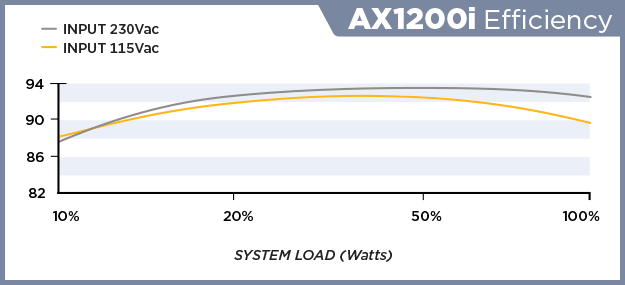
A PSU runs at its best, at around 90% load. That is when it is most efficient (my PSU is GOLD so it doesn't matter), so your claim that it increases my electricity bill is virtually laughable.

ax1200i-efficiency.png


The 580 does very little when im not gaming with physx or doing uni work, or bench marking, or bit coin mining, or using it to render videos and so on.... but its not 98%, and even then, when idle, it uses less than 100W.

Finally it appears your argument is this: "people with money shit me because in my view they waste it" is arrogant in the extreme. I do fluid dynamics and AI at uni, i use my PPU all the time, i gave a solid argument to Xmorpheus regarding the pros and cons, and all you have done is said "i don't like it" amongst other nonsense and assumptions.

Please wait for the OP. In the meantime, i leave you this AX1200 picture ;)

corsair-ax1200-psu.jpg
 
Last edited:
Again.. sigh.. stop making assumptions, go and read, learn and get yourself into a position of knowledge.

A PSU runs at its best, at around 90% load. That is when it is most efficient (my PSU is GOLD so it doesn't matter), so your claim that it increases my electricity bill is virtually laughable. The PSU will PREFER to be at 90% than at 40% load. That is one of the reasons I added the 580 as the system was built and designed around a GTX580 tri-SLI system. 2 x 780Ti plus a 580 is about the same.


The 580 does very little when im not gaming with physx or doing uni work, or bench marking, or bit coin mining, or using it to render videos and so on.... but its not 98%, and even then, when idle, it uses less than 100W.

Finally it appears your argument is this: "people with money shit me because in my view they waste it" is arrogant in the extreme. I do fluid dynamics and AI at uni, i use my PPU all the time, i gave a solid argument to Xmorpheus regarding the pros and cons, and all you have done is said "i don't like it" amongst other nonsense and assumptions.

Please wait for the OP. In the meantime, i leave you this AX1200 picture ;)

So your powersupply consumes MORE power at 40% load than at 90% load? Hmm... I would probably invest in a different power supply then. Thats pretty INefficient if you ask me.
 
Last edited:
So your powersupply consumes MORE power at 40% load than at 90% load? Hmm... I would probably invest in a different power supply then. Thats pretty INefficient if you ask me.

No, its an efficiency curve. Look mate lets take this offline into PM, you clearly have no idea.
 
No, its an efficiency curve. Look mate lets take this offline into PM, you clearly have no idea.

Im not talking about efficiency Im talking about power consumption. If your power supply is consuming more power at a 40% load than at a 90% load there is a problem. I have no issue believing its more efficient at 90% than 40%, as yes most PSUs are that way, however I have a hard time believing that its consuming more power at 40% than 90%.

Your defense to me saying that your 580 is just consuming more power was to say that your PSU consumed more power without the added 580. By claiming that its not increasing your electric bill your saying that your PSU is consuming equal or less power from the wall to produce that extra 200w or whatever needed which I just find hard to believe.
 
Back
Top