
You are using an out of date browser. It may not display this or other websites correctly.
You should upgrade or use an alternative browser.
You should upgrade or use an alternative browser.
Ram over 800Mhz?
- Thread starter Shane
- Start date
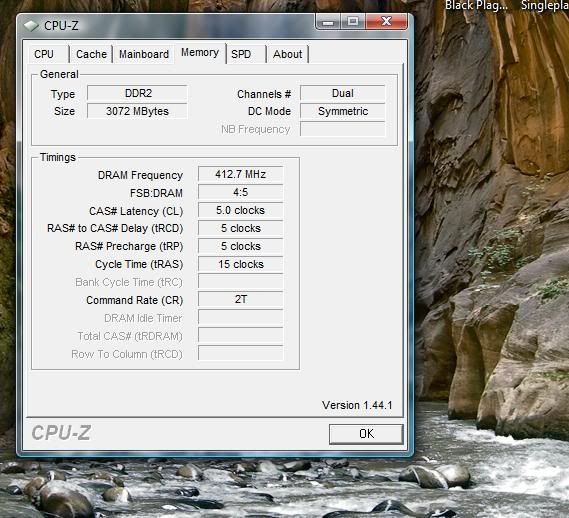


hmmm well thats good then
sorry to hijack threadsbut what does dual channel interleaved mean. ive read a few things about it. still dont understand... is it better then just having symmetrical dual channel?
im not quite sure tbh...sorry.
btw guys im confused by memory timings...are mine bad or what?
im still learning
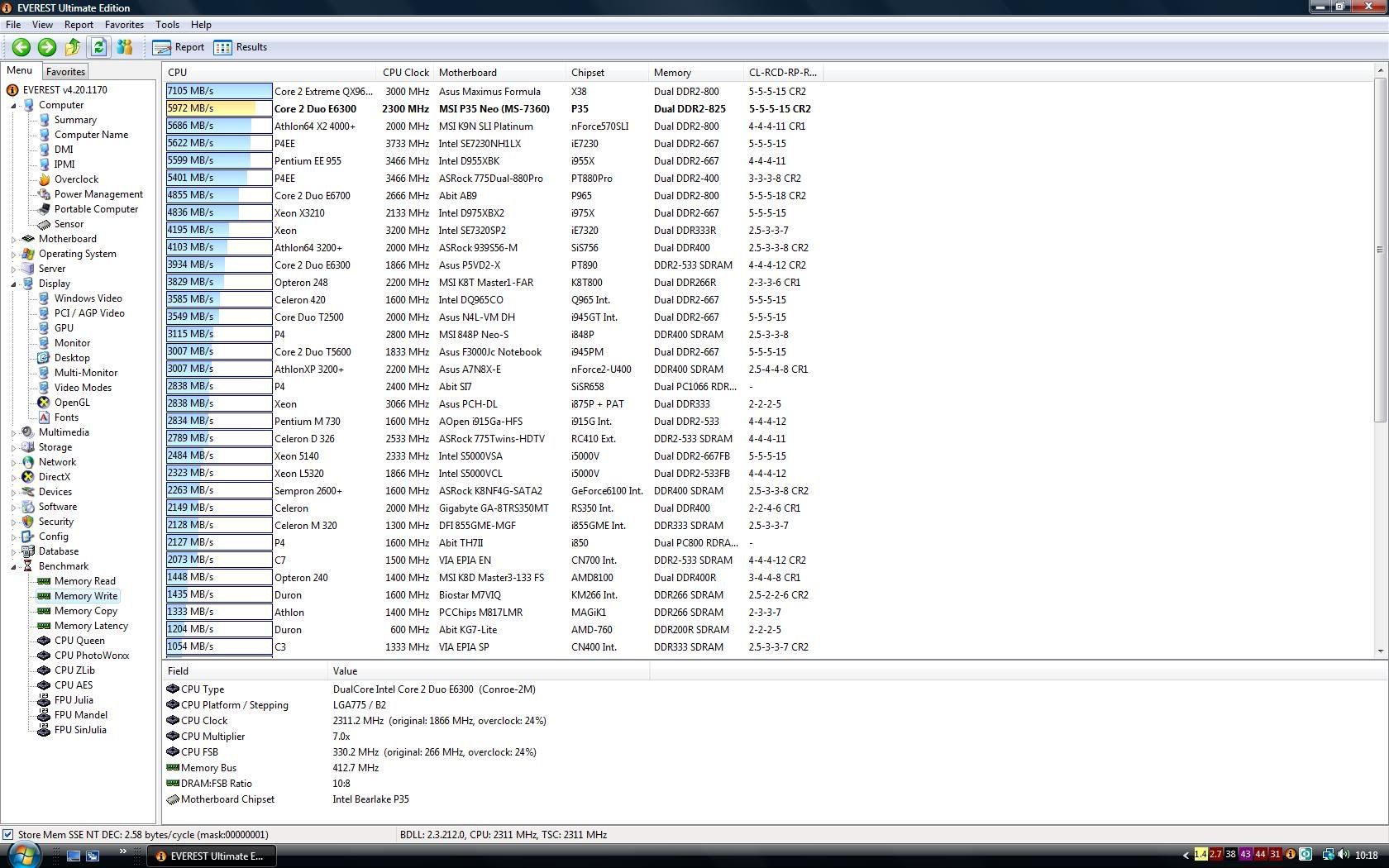
i done a memory write benchmark in everest and these are the results
Last edited:

Your timings are fine. DDR2-800 @ 4-4-4 is fairly common but since you are running DDR2-667 @ ~825MHz (330MHz * 2.5 ---- 266.6MHz * 2.5 = 667)
Dual channel interleaved is dual channel symmetric.
Dual channel interleaved is dual channel symmetric.
Intel said:Single-Channel
The system will enter single-channel mode when only one channel of memory is routed on the motherboard, or if two-channels of memory are routed, but only one channel is populated. In this configuration, all memory cycles are directed to a single channel.
Dual-Channel Asymmetric
This mode is entered when both memory channels are routed and populated with different amounts (MB) of total memory. This configuration allows addresses to be accessed in series across the channels starting in channel A until the end of its highest rank, then continue from the bottom of channel B to the top of the rank. Real world applications are unlikely to make requests that alternate between addresses that sit on opposite channels with this memory organization, so in most cases, bandwidth will be limited to that of a single channel.
Dual-Channel Symmetric
This mode allows the end user to achieve maximum performance on real applications by utilizing the full 64-bit dual-channel memory interface in parallel across the channels with the aid of Intel® Flex Memory Technology. The key advantage this technology brings is that the end user is only required to populate both channels with the same amount (MB) of total memory to achieve this mode. The DRAM component technology, device width, device ranks, and page size may vary from one channel to another.

2048Megabytes
Active Member
Will the RAM life be reduced by running PC2 5300 memory at PC2 6400 speeds?
I'd imagine so but if the voltage isn't rediculously high and it's not overheating it's still going to live longer than it's likely to be used for.
well its still at stock 1.8v

also all the memory has heatspreaders built on like this

2048Megabytes
Active Member
I don't understand how the memory could be running at PC2 6400 speeds at 1.8 volts.

Geoff
VIP Member
DDR2 800 can easily run at 1.8v, especially when the timings are relaxed and have a CL of 5.I don't understand how the memory could be running at PC2 6400 speeds at 1.8 volts.
2048Megabytes
Active Member
Okay, rereading the thread I think I understand now. When he over clocked his processor it likely bumped up his voltage on his RAM as well. The memory is probably running at 2.0 volts or higher.